The Legendary Foundation of Catanzaro
Contenuto dell'articolo
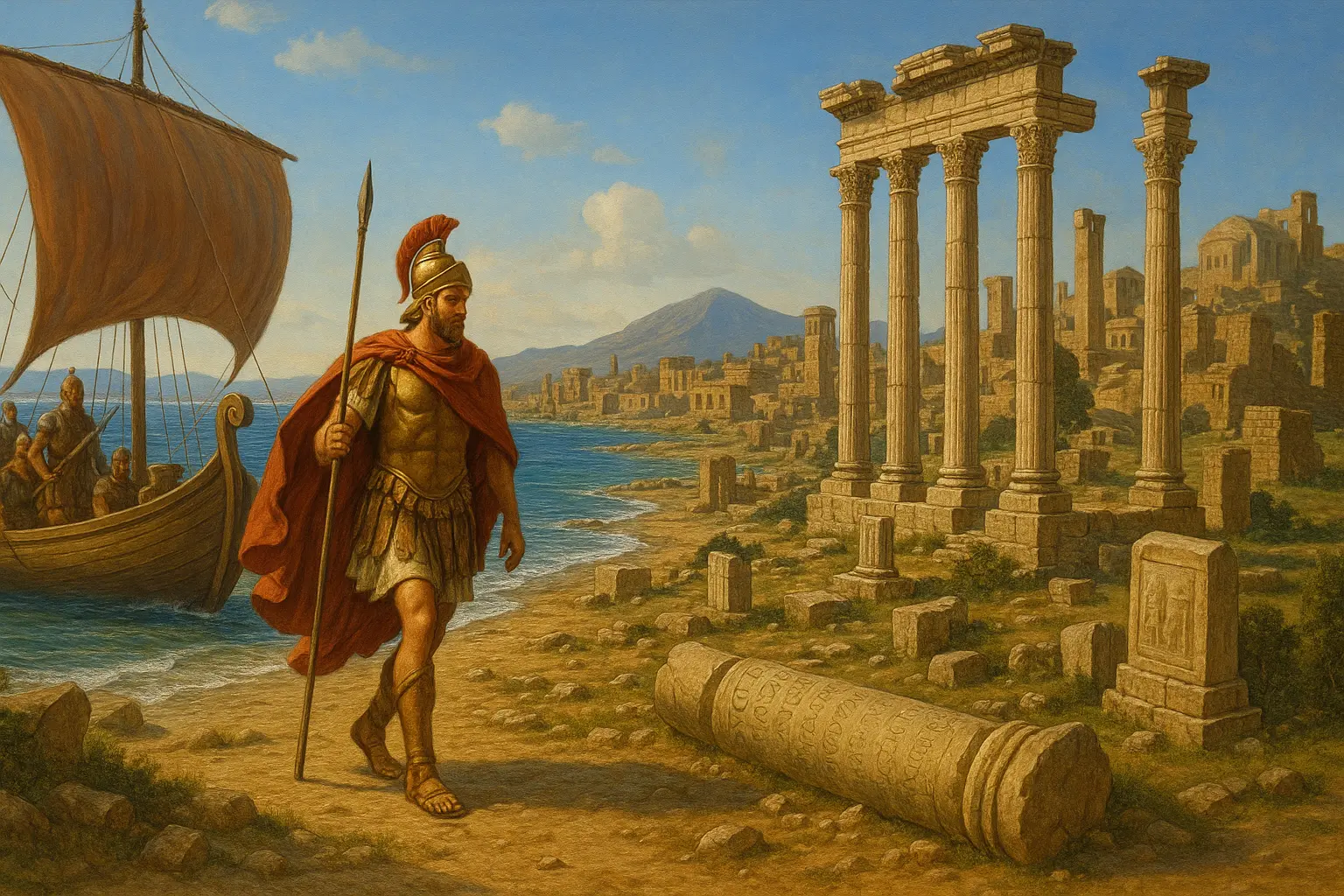
The history of Catanzaro has its roots in an intertwining of myth and reality, which unfolds from the ancient Skilletion, a Magna Graecia city located a few steps from the current marina district.
Legend has it that Odysseus, the Homeric hero, is the founder of this city overlooking the Ionian Sea, while other traditions attribute this honor to Menestheus, the Athenian returning from the Trojan War.
Why this particular place.
The Isthmus of Catanzaro is the narrowest point in Italy, where the Gulfs of Sant'Eufemia and Squillace are only about thirty kilometers apart, a necessary passage along the ancient route between East and West.
According to some scholars, it was here that Odysseus landed, in the mythical "Land of the Phaeacians" described by Homer, with his palace located in the area of Teura, the ancient Tiriolo.
Thus, legend has it that Odysseus founded the ancient Skilletion, later known as Scolacium under the Romans, a stronghold of control on the Ionian side of the isthmus, while on the other side Terina dominated.
Founded as a military outpost at the beginning of the 6th century BC, Skilletion went through centuries of vicissitudes; in addition to its strategic functions, it became a place of decisive conflict during the Second Punic War.
Between 218 and 202 BC, during this conflict that saw Italy siding with Carthage against Rome, Skilletion was refounded by Hannibal and renamed "Castra Hannibalis".
It was in this area that one of the bloodiest battles in ancient history took place.
In 207 BC, between Montepaone and Soverato, the Roman troops led by the consul Marcus Claudius Marcellus clashed with the Carthaginian army of Hannibal. Eighty thousand lives were lost in this ferocity, while the battlefield, bordered to the north by the "Tumulus" of the Corace valley, forever changed the face of those places.
The "Tumulus", mentioned by Pliny, Livy, and Plutarch, was the place where Hannibal ambushed a Roman scouting group, killing the consuls Marcellus and Crispinus. Their heads were brought to Rome as a grim warning. Even today, along the old state road 106, a granite column commemorates this episode, with the Latin inscription celebrating Hannibal's victory and the name "Piano Sanguinario" attributed to that plain.
After these tumultuous events, the city was refounded by Gaius Gracchus and experienced a period of prosperity especially during the Julio-Claudian era, with monuments that tell of its prestige. Under Emperor Nerva, around the end of the 1st century AD, the colony Minerva Nervia Augusta Scolacium was born, a new testament to the strategic importance of the place.
In Byzantine times, the area gave birth to Flavius Magnus Aurelius Cassiodorus, a renowned scholar and founder of the Vivarium, one of the first universities in Europe, where ancient texts were transcribed and preserved. This centr. -->