Vai alla sezione principale
Vai alle informazioni attrazione
Vai alla descrizione
Vai alle indicazioni
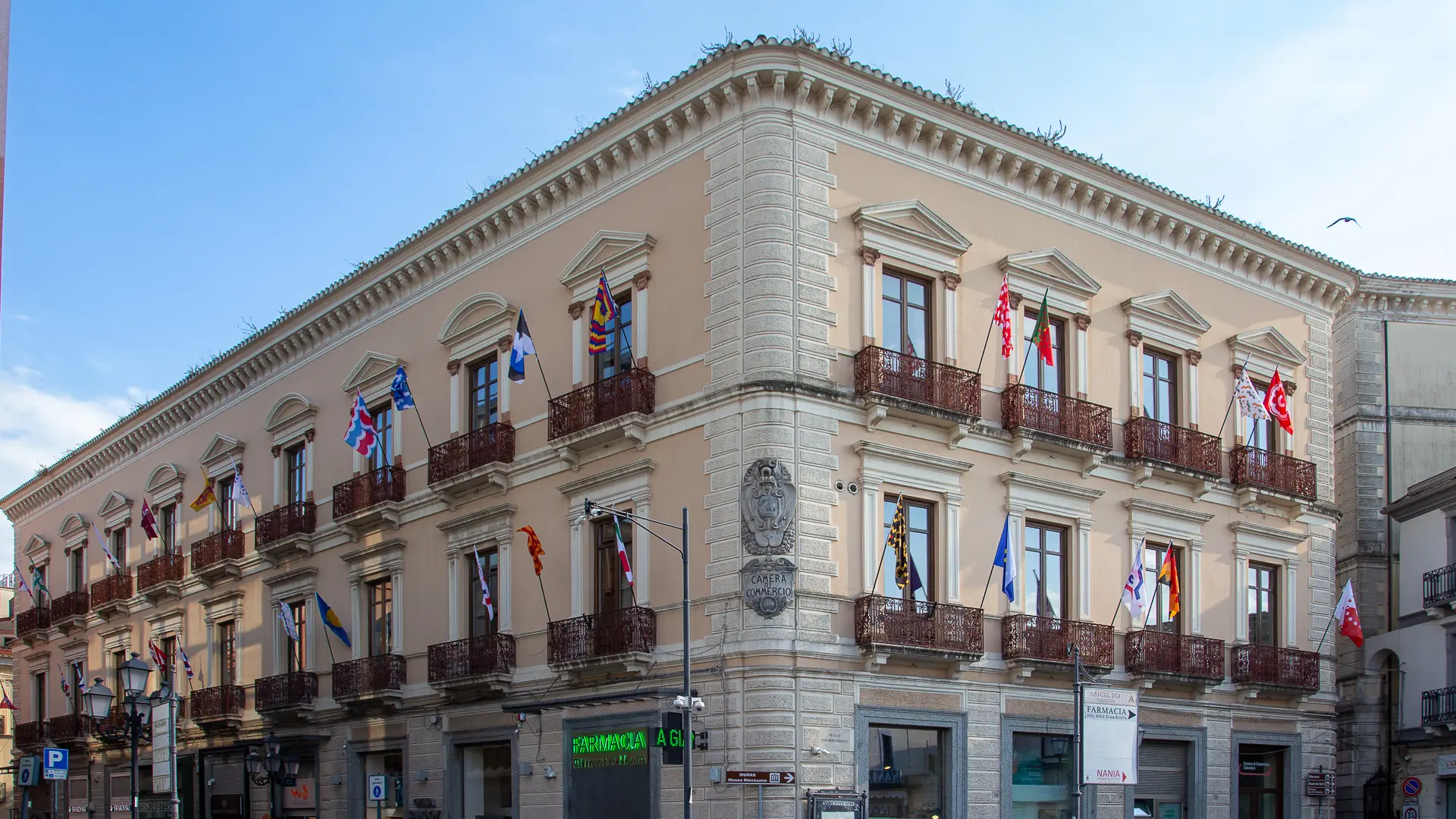
Palace of the Chamber of Commerce (formerly Grimaldi-Montuori): where Catanzaro was born
Accessibility
- Family friendly
Descrizione attrazione
Piazza Bernardino Grimaldi - 17th Century, renovations 1879
Architects: Michele Manfredi and Vincenzo Parisi
Where the elegant headquarters of the Chamber of Commerce stands today, over a thousand years of city history are layered. This palace, which has crossed centuries changing its name and function but always maintaining a central role in the life of the city, guards an extraordinary secret: here, according to tradition, stood the first cathedral of Catanzaro, dedicated to Saint Michael the Archangel and consecrated in the 10th century.
The Legendary Origins: The First Cathedral
According to the "Historical Memoirs" by Vincenzo D'Amato from 1670, the first inhabitants of the city "built the Mother Church in that very place where today is the Main Square under the Title of St. Michael the Archangel, and that was consecrated by Archbishop Stefano of Reggio at the request of Flagizio Procurator of Niceforo."
When the new Norman Cathedral was built in 1121, the ruins of the ancient church were still visible in the time of the historian D'Amato. Over time, these were progressively destroyed to make way for the Monte di Pietà with its small church and the adjacent palace of the Grimaldi family.
The Grimaldi Dynasty (1644-1851)
The Beginnings: Cristofaro Pallone and Bernardino Marincola
The first documented records of the building date back to 1644, when Captain Cristofaro Pallone sold his part of the palace to Gregorio Grimaldi. A part of the building was already owned by Bernardino Marincola, baron of Sellia, a testimony of the complex noble ownership of the time.
The Consolidation: The Grimaldi Masters
In 1665 the palace belonged to Giovanni Grimaldi and remained in the family until 1851, when the last owner Peppina Grimaldi sold her share to Cavalier Pasquale Montuori, marking the end of over two centuries of noble ownership.
The Eighteenth-Century Urban Context
In 1769 the palace was in a strategic position:
- To the south with the Monte di Pietà palace
- In the center between the Scarpari street (now via Duomo)
- The Barbieri street (now corso Giuseppe Mazzini)
- The Merchants square (now Piazza Bernardino Grimaldi)
This central location made it one of the focal points of the city's commercial and social life.
The Montuori Era: Entrepreneurial Bourgeoisie
The Change of Ownership: Symbol of an Era
The transition from the Grimaldi to the Montuori in 1851 is emblematic of the post-unitary social transformation. The Bourbon Restoration and the reconstruction after the earthquakes of 1783 and 1832 led to the consolidation of the upper bourgeoisie and the sale of many noble residences.
Pasquale Montuori: The Visionary Entrepreneur
Pasquale Montuori, a builder entrepreneur also involved in public works, acquired the palace in successive phases:
1840: first portion
1851: second portion
1970s: premises of the Monte dei Pegni and Maritaggi
This last acquisition, sold by Mayor Francesco De Seta and by the president of the Congregation of Charity Giuseppe Rossi,...